Manual of Soil Properties and Land Preparation
| Site: | immaculatewasike.gnomio.com |
| Course: | Crop production |
| Book: | Manual of Soil Properties and Land Preparation |
| Printed by: | Wasike |
| Date: | Saturday, 19 September 2026, 4:29 PM |
Description
A comprehensive guide covering soil texture analysis and the transition into seedbed construction.
Learning Modules
Module 1: Soil Fundamentals
Introduction to Soil Formation and Parent Materials.
Understanding the pH scale and its impact on crop growth.
Module 2: Soil Texture Analysis
The Ribbon Test: Field techniques for texture identification.
Using the Soil Textural Triangle for official classification.
Module 3: Land Preparation
Primary vs. Secondary Tillage: Objectives and timing.
Tools and machinery used for field clearing
Introduction to Soil Formation
Soil is a natural body consisting of layers (soil horizons) that are composed of weathered mineral materials, organic matter, air, and water. Soil formation is a slow process governed by five main factors:
Parent Material: The raw geologic material (usually rock or organic deposits) from which the soil is formed.
Climate: Temperature and moisture levels that affect the speed of chemical reactions and biological activity.
Topography: The slope and "lay of the land" which affects drainage and erosion.
Biological Factors: Plants, animals, and microorganisms that add organic matter.
Time: The duration over which the other four factors have been interacting.
The pH scale ranges from 0 to 14.
Acidic (0–6.9): Often found in high-rainfall areas.
Neutral (7.0): Ideal for most common crops.
Alkaline (7.1–14): Often found in arid or chalky regions.
Soil formation is influenced by the interaction of:
Parent Material: The original rock type.
Climate: Temperature and rainfall patterns.
Organisms: Living things like bacteria and plants.
Relief: The slope and aspect of the land.
Time: How long the processes have been occurring
Steps for the Ribbon Test:
Moisten the Soil: Take a handful of soil and slowly add water until it reaches a consistency like putty.
Knead: Squeeze the soil to break up any lumps. If it is too sticky, it has high clay; if it feels gritty, it has high sand.
Form a Ribbon: Roll the soil between your thumb and forefinger to squeeze it upward into a ribbon.
Measure: > * High Clay: Creates a long, flexible ribbon (over 5cm).
Loam: Creates a medium ribbon (2.5cm – 5cm).
High Sand: Will not form a ribbon or breaks immediately
Use the percentages found in your analysis to locate the soil type:
- Follow the Clay line horizontally.
- Follow the Silt line downward to the left.
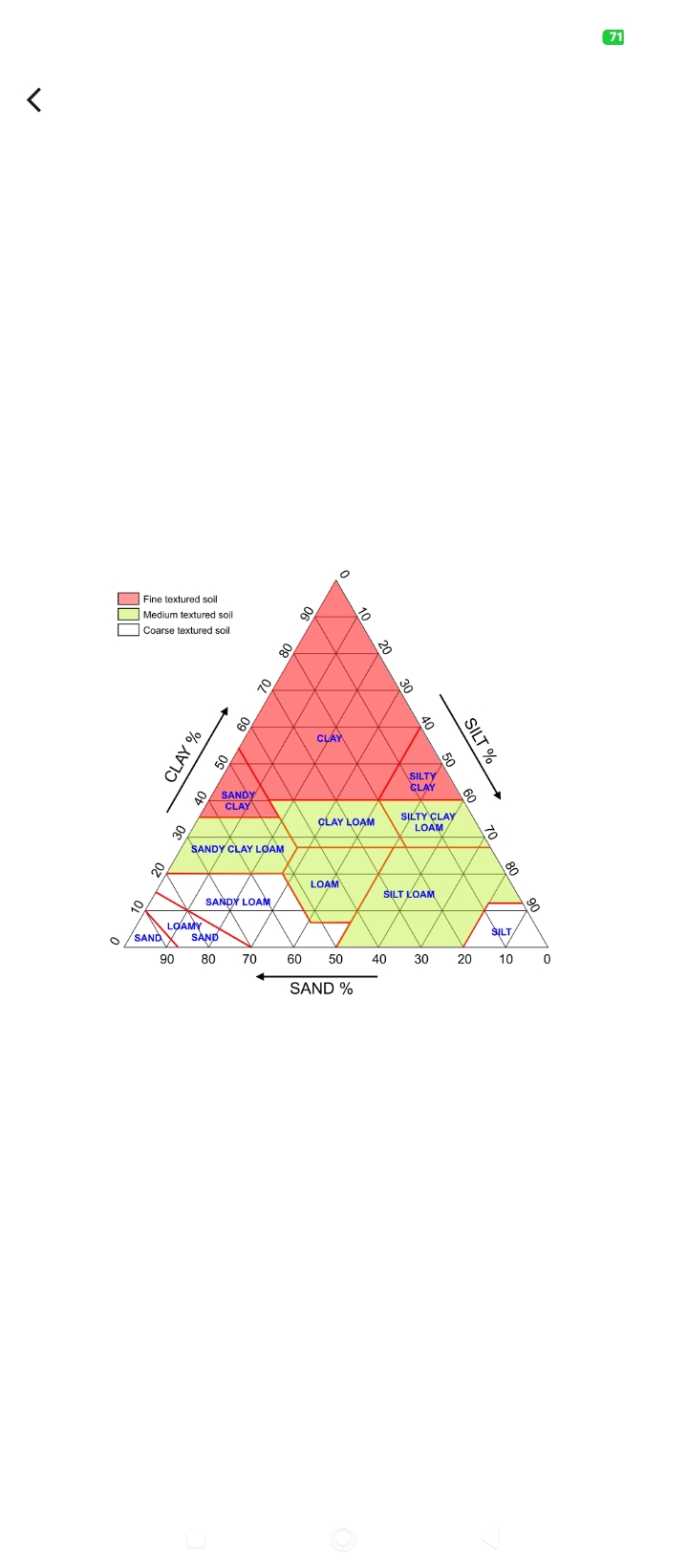 Follow the Sand line upward to the left.
To execute the test:
1.Form a soil ball about 2.5 cm in diameter.
2.Squeeze the soil between your thumb and forefinger.
3.If a ribbon forms, measure its length before it breaks.
Effective land preparation is the bridge between soil analysis and successful planting. This chapter details the mechanical processes used to alter soil structure, manage weeds, and incorporate organic matter. By understanding the distinction between different tillage stages, farmers can optimize the seedbed environment while minimizing soil compaction and erosion.
1. Primary Tillage
Objectives: To open up compact soil, incorporate organic matter or crop residues, and improve soil aeration.
Timing: Usually performed when the soil is at its most "friable" moisture level, often after the first rains or after a previous harvest.
2. Secondary Tillage
Objectives: To pulverize soil clods, level the field surface, and create a firm seedbed for better seed-to-soil contact.
Timing: Follows primary tillage, typically closer to the actual planting date to prevent moisture loss or re-compaction
Selecting the right machinery is essential for efficient land preparation while protecting soil structure.
Clearing Tools: Machetes, slashers, and axes for manual clearing; bulldozers or brush cutters for mechanical clearing.
Primary Tillage Machinery: Moldboard plows (for turning soil) and disc plows (for rocky or hard ground).
Secondary Tillage Machinery: Harrows (disc or tooth), cultivators, and rollers for refining the seedbed.